
What Are the Design Concepts Behind European Ultra-Luxury Sliding Doors?
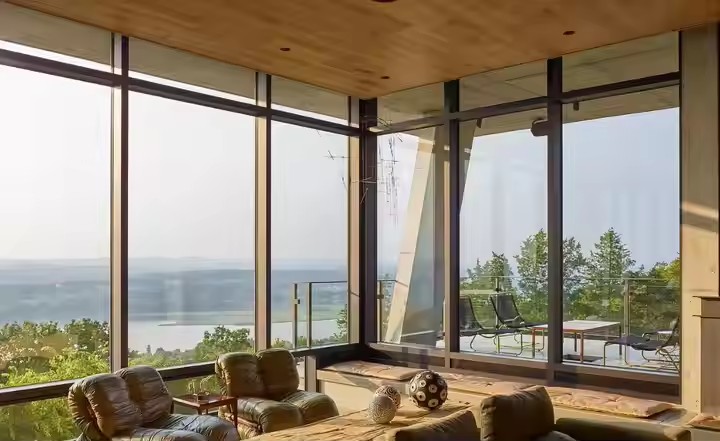
I. Minimalist Aesthetics: Re-defining Spatial Boundaries Through “Visual Disappearance”
The core aesthetic philosophy of European ultra-luxury sliding doors lies in subtractive design—minimizing the visual presence of the door itself to achieve seamless spatial continuity. Schüco panoramic sliding doors exemplify this approach through expansive glass panels paired with ultra-slim profiles, compressing frame widths to the extreme so the door becomes a transparent “spatial picture frame,” allowing outdoor landscapes to flow naturally into interior spaces.
Seibao integrates French romanticism with modern minimalism, replacing sharp angles with fluid curves. Combined with an ultra-narrow 6.8 cm frame design, visual transparency is increased by approximately 30%.
This minimalism extends beyond appearance into meticulous detailing. Brands such as Boffi adopt concealed hinges and recessed handles to achieve a clean, hardware-free façade, while French Steel’s ultra-luxury series eliminates track protrusions through precision engineering, creating a flush connection between door and floor—allowing robotic vacuums to pass freely. Such restrained minimalism delivers a calm, refined visual experience that strongly aligns with contemporary design preferences.

II. Material Elegance: Craftsmanship That Elevates Natural Texture
Ultra-luxury design rejects material excess, instead amplifying the inherent beauty of natural materials through advanced craftsmanship. German brands favor aerospace-grade 6063-T5 aluminum alloys, treated with specialized anodizing processes to achieve a refined matte finish and top-tier wind-pressure resistance (Class 9 under international standards), ensuring stability even in oversized door systems.
Italy’s Lualdi Koan series combines trapezoidal solid-wood slats with 6 mm tempered glass; the hand-assembled wood grain contrasts elegantly with the glass’s transparency, achieving a balanced interplay of warmth and coolness. A single panel can be priced at up to €8,000.
Glass, as a core material, is further elevated to an artistic medium. Daziran Doors & Windows’ Glass series features diamond-grade precision-polished edges paired with 45-degree three-dimensional diamond-pattern muntins, allowing ultra-clear glass to refract brilliant light. Schüco, meanwhile, equips its systems with triple-glazed Low-E insulating glass as standard, delivering thermal and acoustic performance while creating a soft, French-style diffused lighting effect.
Metal elements are used sparingly—often as delicate linear accents—such as externally mounted double-sided metal grilles in French vintage collections, enhancing spatial depth through the play of light and shadow.
III. Functional Innovation: Technology in Service of Comfort
European ultra-luxury design consistently places human experience at its core, integrating advanced technology into everyday use. In terms of operation, French Steel’s zero-gravity sliding system removes both floor and ceiling tracks, creating a floating opening effect. Carbon-fiber-reinforced glass rollers endure over 100,000 test cycles without failure, with sliding noise kept below 35 dB.
Motorized operation has become a premium standard: Schüco panoramic doors can be remotely controlled via smartphone apps, fully integrating with modern smart-home ecosystems.
Adaptability to extreme environments highlights the sector’s technical sophistication. Oujia sliding doors employ a patented “whale-tail” drainage channel that rapidly evacuates water during heavy rainfall, achieving the highest 9A water-tightness rating under EN 14351-1 standards. Ultra-luxury products meeting this standard can reach U-values as low as 1.2 W/(m²·K), effectively blocking winter cold. Combined with sound insulation ratings above Rw 40 dB, interiors are transformed into serene, insulated sanctuaries.
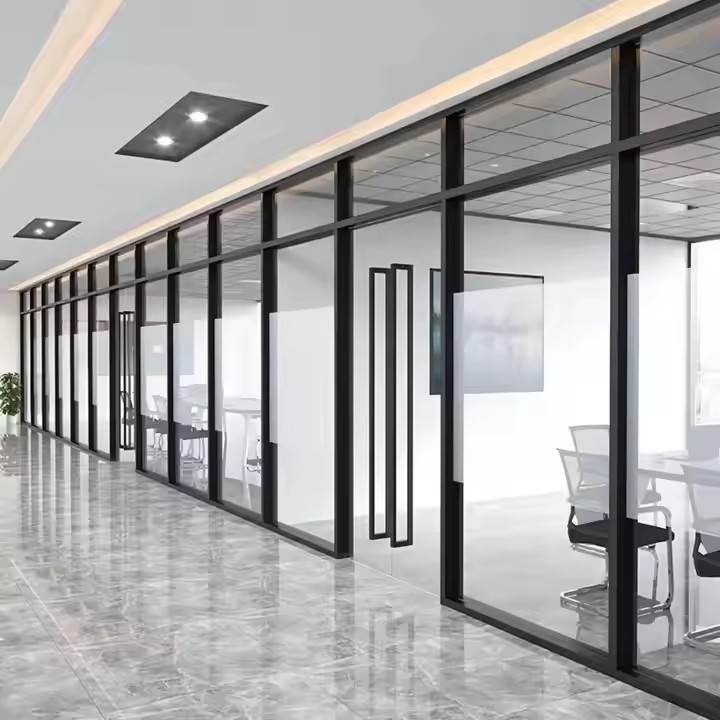
IV. Bespoke Integration: Scene-Driven Personal Expression
At the heart of ultra-luxury lies exclusivity. Customization has evolved from mere dimensional adjustment to fully scenario-based solutions. Lualdi supports door heights of up to 3 meters, while Schüco’s modular systems accommodate both double-height villas and compact apartments. Triple-panel synchronized opening systems create extra-wide passages, facilitating the movement of large furniture.
Aesthetic customization further reflects human-centric design. In 2024, Boffi introduced its Natural Spectrum color palette—including Tuscan Sandstone White and Alpine Glacier Gray—secured with nano-coating technology to ensure color stability for over a decade. The Rose Island W-Series uses an internal glazing-seal process, leaving no visible adhesive marks and enabling seamless integration with minimalist, retro, or eclectic interiors.
Functional modules such as integrated blinds and mosquito screens can be freely combined, enabling smooth transitions between full daylighting, partial shading, and micro-ventilation scenarios.
V. Sustainability: The Enduring Value of Luxury
Contemporary European ultra-luxury design embraces sustainability as a defining principle, achieving a balance between opulence and environmental responsibility. In material selection, the Rose Island W-Series employs formaldehyde-free metal and glass combinations compliant with EU environmental standards, while French Steel utilizes thermally broken steel that offers corrosion resistance alongside energy efficiency—ensuring service lifespans measured in decades.
Energy-saving technologies permeate the entire design process. The integration of triple-glazed insulating glass with multi-seal structures delivers thermal performance far exceeding standard products. When paired with adjustable ventilation modes, these systems significantly reduce energy consumption for heating, cooling, and lighting—embodying the philosophy of “green luxury.”